Key answers
- Why this device matters
- The target audience for this device comprises precision metrology laboratories, quantum optics researchers, coherent FMCW LiDAR architects, and microwave-photonics systems engineers. In long-haul optical frequency transfer networks linking optical atomic clocks across hundreds of…
- State of the art
- The table is a literature comparison. It does not describe results from the present repository.
- What the model calculates
- The accepted build reports these assumed-input metrics:
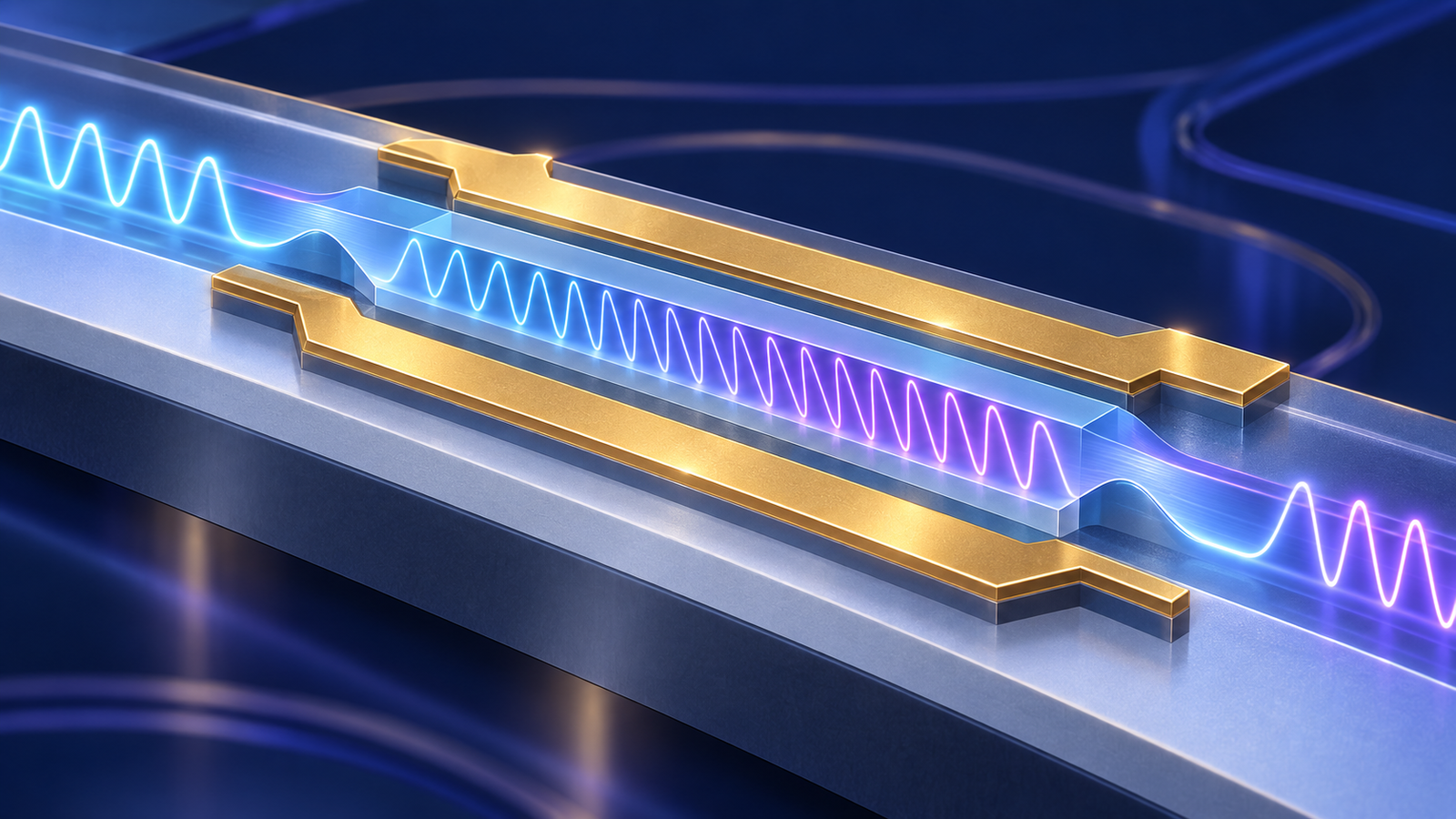
A transparent engineering model for Thin-film lithium niobate bidirectional serrodyne optical frequency shifter
Method estimate from assumed inputs. Not a measurement, foundry specification, or tape-out.
Why this device matters
The target audience for this device comprises precision metrology laboratories, quantum optics researchers, coherent FMCW LiDAR architects, and microwave-photonics systems engineers. In long-haul optical frequency transfer networks linking optical atomic clocks across hundreds of kilometers of optical fiber, acoustic and thermal fluctuations along the fiber link corrupt phase stability. Canceling this phase noise requires establishing an active phase compensation loop using an optical frequency shifter to introduce an intentional carrier offset, which enables the system to isolate the round-trip signal from parasitic Rayleigh backscattering. In quantum systems, addressing solid-state spin centers (such as nitrogen-vacancy or silicon-vacancy centers in diamond) requires continuous-wave laser frequencies to be rapidly shifted across gigahertz ranges to overcome emitter inhomogeneous broadening. Similarly, coherent FMCW LiDAR architectures rely on frequency-shifted local oscillators to eliminate zero-frequency homodyne blind spots and unambiguously resolve target velocity from Doppler shifts.
State of the art
| Approach | Demonstrated role | Evidence used in this note | Engineering limitation |
|---|---|---|---|
| Bulk acousto-optic modulator | Mature spatial frequency shifting | Commercial and laboratory baseline discussed by Shao et al. | Macroscopic optical alignment and RF power |
| Integrated TFLN acousto-optic shifter | Mode conversion near 3 GHz | Measured device reported by Shao et al. (2020) | Electromechanical conversion and mode-management complexity |
| Broadband serrodyne phase modulation | Spectral-purity transfer and optical-frequency control | Experimental system reported by Barbiero et al. (2023) | Suppression depends on drive-waveform fidelity |
| Bidirectional LNOI serrodyne shifter | Integrated bidirectional frequency transfer | Measured device reported by Qiu et al. (2025) | Requires an implementation-specific traveling-wave and spectral model |
The table is a literature comparison. It does not describe results from the present repository.
What the model calculates
The accepted build reports these assumed-input metrics:
- ideal_conversion_efficiency: 0.9997840306979627
- flyback_ssr_model: 30.45757490560675
- flyback_ssr_model_F0p03_dB: 30.45757490560675
- flyback_ssr_model_F0p10_dB: 20.0
- amplitude_error_csr_trend: 53.84263608342229
- vpi_length_scaling: 2.0
- reverse_walkoff_trend: 5.82126910493308e-05
These are method estimates, not measurements.
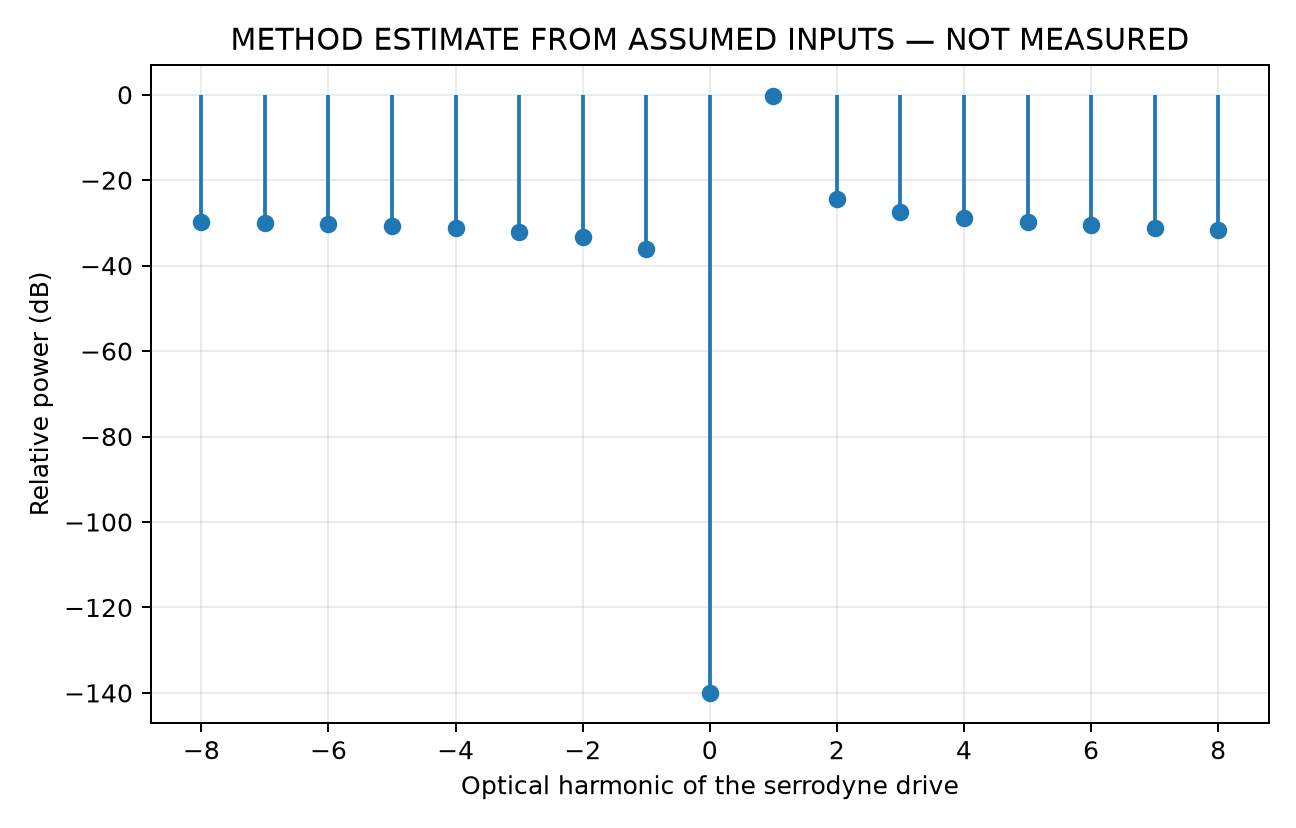
The accepted package is an analytic Thin-film lithium niobate bidirectional serrodyne optical frequency shifter model. It implements linear Pockels phase ramp from a 2-Vpi sawtooth on traveling-wave electrodes; reverse-wave velocity mismatch with assumed inputs, then reports conversion efficiency, flyback-limited spurious suppression, amplitude-error carrier leakage, half-wave voltage scaling, and reverse-wave walk-off. Literature measurements cited below are baselines, not outputs of this repository.
Reproduce the result
git clone https://github.com/ShahramPhotonics/silicon-photonics-eda-portfolio.git
Limits
- Assumed inputs. Not measured.
- No FDTD mode solver and no HFSS/quasi-TEM extraction in this packet.
- Qiu 2025 and Assumpcao 2024 metrics are literature baselines, not factory results.
- lxt_pdk_gf is an optional later layout backend; film thickness is not pinned.
- Photorefractive drift and wafer-scale Vpi statistics are unpublished here.
- GHz SSR is electronics-limited; no amplifier model is included.
- Portfolio item 04 (educational LNOI ring) is not a predecessor implementation of this topology.
Primary sources
- https://doi.org/10.1364/OL.544605
- https://doi.org/10.1038/s41467-024-54151-w
- https://doi.org/10.1364/OE.399540
- https://doi.org/10.1364/OL.484805
- https://doi.org/10.48550/arXiv.2106.01169
- https://doi.org/10.48550/arXiv.2604.08637
The immutable code URL is https://github.com/ShahramPhotonics/silicon-photonics-eda-portfolio/tree/ac13872c2b1bb13b673eadddd7c251af4e1febe1/52-tfln-bidirectional-serrodyne-ofs.
Read more PhotoBattery notes at https://photobattery.ca/blog/.

Leave a Reply